
Kingston upon Thames has been ranked the second “least democratic” borough in London in a recent report, with campaigners warning that the borough is at risk of ‘undemocratic’ results in the May council elections.
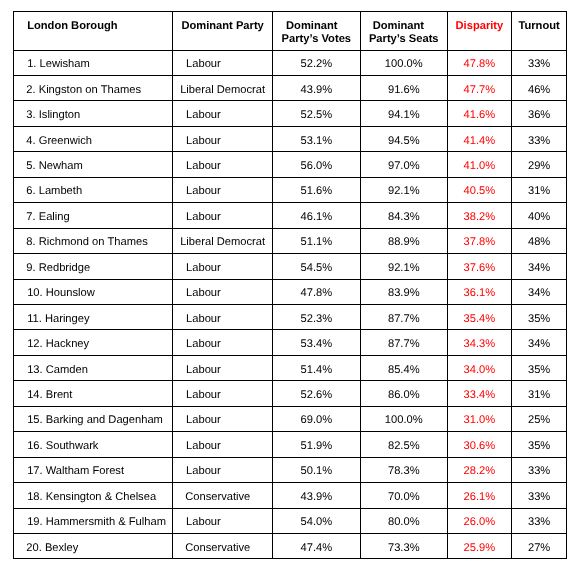
A new analysis of the 2022 local election results by The Supervote Project claims the borough of Kingston has one of the widest gaps in the capital between the share of votes cast and the number of council seats won.
The Supervote Project founder, David Green, warns that Kingston could see a similar outcome in the upcoming borough council elections on May 7th.
According to the report, the Liberal Democrats secured 44 of the borough’s 48 council seats, more than 90%, despite winning just over 40% of the overall vote. The campaign calculates this as a 48% vote-to-seat disparity, placing Kingston second only to the London Borough of Lewisham for disproportionality.
Credit: The Supervote Project
English council elections use the first-past-the-post system, meaning that candidates with the most votes in each ward win the available seats, even if their party does not have the majority of support across the whole borough.
In practice, this can lead to one party winning most of the seats, even if most residents voted for different parties. If a party comes second everywhere, it can receive the majority of votes overall, but end up with little to no representation.
Northern Ireland, Scotland, and Wales all use the Single Transferable Vote system for proportional representation.
“It’s high time English Councils caught up,” said Green.
In 2022, the Conservative Party won nearly a quarter of the total vote in Kingston but ended up with just three seats. The Labour Party and The Green Party, with 13% and 8% of the vote respectively won no seats at all.
“There is something very wrong with a voting system that has the ability to award over nine out of ten seats to a party that has won just over four out of ten votes,” said Green.
Green’s campaign, The Supervote Project, seeks to reform the UK’s voting system. Instead of focusing on general elections, as other voting reform campaigns do, The Supervote Project zone in on local council elections, claiming that damage is done at the grassroots by the first-past-the-post system.
Kingston resident, Kathryne Shrimpton, complained of the first-past-the-post system. “We need proportional voting. I was sad that the supplementary vote system method used to vote for the London Mayor in 2021 wasn’t continued,” she said.
The supplementary vote system, used in the London Mayor election, differs from first-past-the-post as it allows voters to select a second choice.
Under first-past-the-post, the system used in Kingston’s council elections, the candidate with the most votes wins, even if they have less than half of the total. There is no second round and no redistribution of votes.
By contrast, the supplementary vote system gives voters a second preference and, if no candidate wins more than 50% of first-choice votes, the voters’ second preferences are added.
This means that the winning candidate will always have accrued more than half of the vote, once the second preferences are considered, a method thought to be more proportional by some.
Credit: Kingston Council
Although Kingston had the second highest discrepancy between votes and seats awarded, it also had the second highest voting turnout, a more positive result for the borough.
However, although the voting turnout was greater than in other London boroughs, more than half of Kingston voting-eligible residents did not vote in the 2022 election.
Green blamed the turnout on political disillusionment. He said: “Evidently, over half of Kingston voters felt so disconnected with the democratic process that they chose not to vote.”
“It doesn’t bode well for the forthcoming Borough elections,” he added.
Roy Kwei, a Kingston resident, gave The Courier a more simplified reason for the voting turnout. “Kingston residents can’t be bothered to vote,” he said.
The Supervote Project are calling on Kingston Council Leader, Andreas Kirsch, to lobby the government for a reform of the voting system before the next borough council election takes place in May.
The Courier has approached Kingston Council for comment on the findings of the report.