
Artist Abbas Zahedi on his new artist residency at the Stanley Picker Gallery
There is some art which can only be appreciated through meticulous focus. Think Hieronymus Bosch or Pieter Bruegel the Elder, whose paintings are saturated with masterly minutiae. However, there is other art which can only be appreciated through a surrender of rational scrutiny; art which exists in the blur of an unfocused eye. The artwork by London-based British Iranian artist Abbas Zahedi is of this brilliant second kind.
Zahedi’s work is often described as an inquiry into “dissociative realism”. He achieves this through an interdisciplinary approach which appeals simultaneously to numerous senses – sight and hearing – to allow the artworks, and himself, to hover between the realms of reality and dissociation.
“In my own practice, I’m quite interested in this role of dissociation,” said Zahedi, whose latest sonic work is currently exhibited at the Stanley Picker Gallery. “I noticed that when I’m in this dissociated condition, I kind of lose touch with the world, with my body, the surroundings, but somehow the sounds still carry through.”
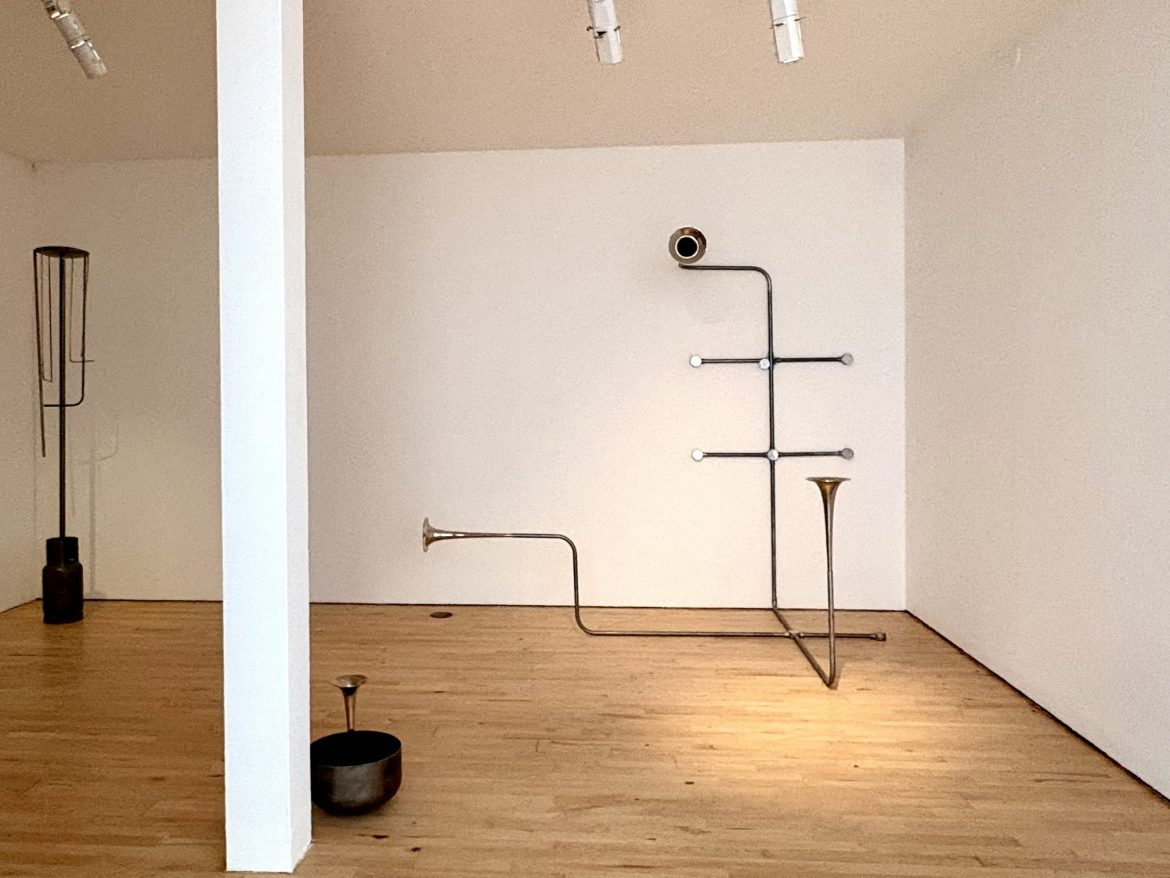
Composed of chromed forms with trumpet-like endings, Zahedi’s new installations stretch vertically and horizontally within the gallery space. Low, resonant tones echo around the room. It remains intentionally unclear whether the sound is produced by the sculptures or by the space they occupy. As a result, the distinction between interior and exterior begins to blur.
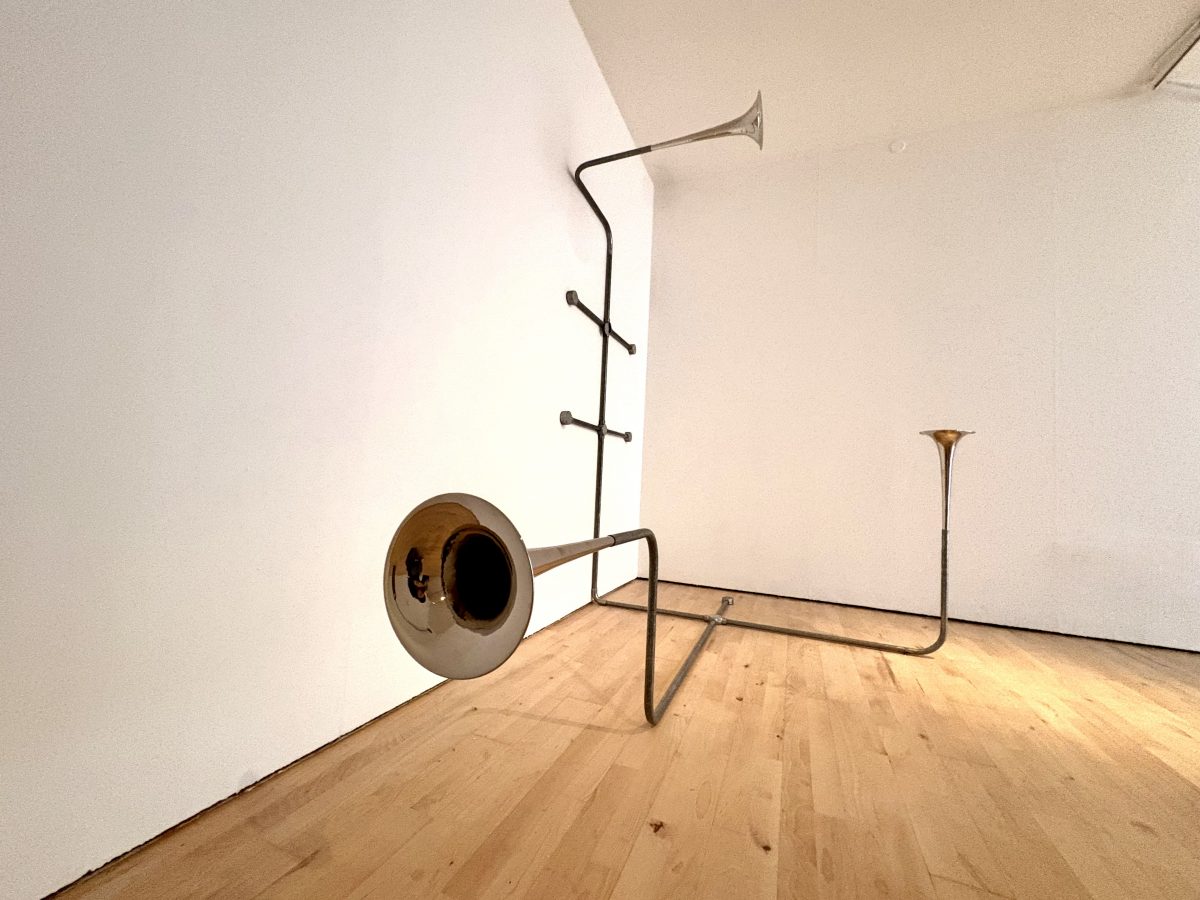
The artist said of his piece: “The work is in a way trying to realise those dissociative things which are very much attached to the sounds that they carry back or through with them.”
Zahedi’s work is part of the exhibition “Attack Decay Sustain Release”, launched at the Stanley Picker Gallery in late January.
The exhibition explores the relationship between sound and artistic production through a ten-week artist residency programme featuring the collaborative efforts of Turner Prize winner Nnena Kalu, Rebecca Kressley and Stanley Picker Fellows Sophie Huckfield and Zahedi.
In keeping with the wider collaborative nature of the exhibition, Zahedi’s art can be said to operate in a third realm too: that of shared reality. Collaboration, which he describes as a “default” in his work, becomes another way for him to sustain a collective sense of presence.
“Collaboration is a survival methodology to stay in touch with a common shared reality. It’s something that I feel like we are losing,” said Zahedi. “So, for me, situating these efforts within an art space and public gallery spaces, is my way of keeping that public space open and still allowing this kind of inquiry into a ‘commons of shared realities’.”
Ultimately the artist wants us to come along and experience his work without thinking about it too much. To come and just be.
“By situating ourselves too much in a materialist sense of reality,” he said, “we’re missing a big part of the picture of what it means to be.”
“Attack Decay Sustain Release” will remain open to the public until Saturday, 28 March, the final day of the Symposium stage.
For more information about the programme, visit the Stanley Picker Gallery website.