
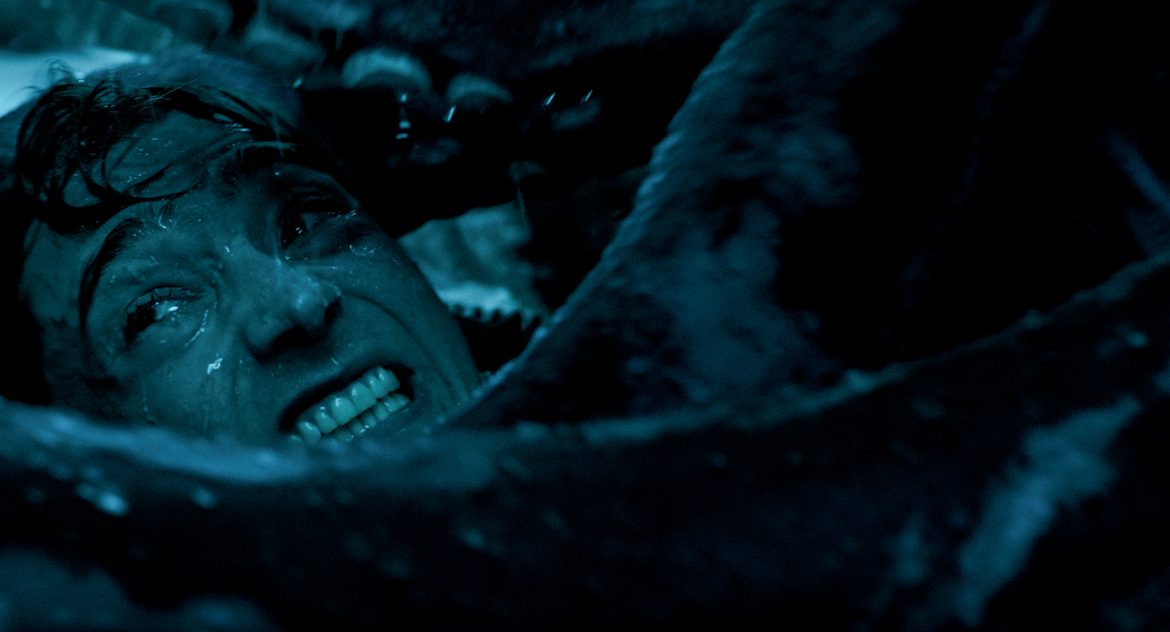
Austin Abrams gets swallowed by a whale in a book adaptation weighed down by a premise it can’t escape.
The last month has seen Austin Abrams become a star by torture, with two leading roles, in Resident Evil and his most recent Whalefall, spent covered in blood, goop, and the skin-peeling stomach acid of a whale that has swallowed him whole. He emerges from both as a bona fide and rugged star, even when the shallow premise of his latest film severely limits what he is able to do.
Whalefall is adapted by Brian Duffield from the 2023 novel of the same name by Pulitzer-winner Daniel Kraus, who also co-authored the script. Abrams plays Jay Gardiner, son of the abrasive but wildly talented diver, Mitt Gardiner (played by Josh Brolin). After being diagnosed with cancer, Mitt (Brolin) decides that he would rather drown himself in the ocean than suffer a slow death in a hospital bed. Jay (Abrams) dives into a raging ocean to seek out his father’s sunken remains, only to be swallowed up by a sperm whale.
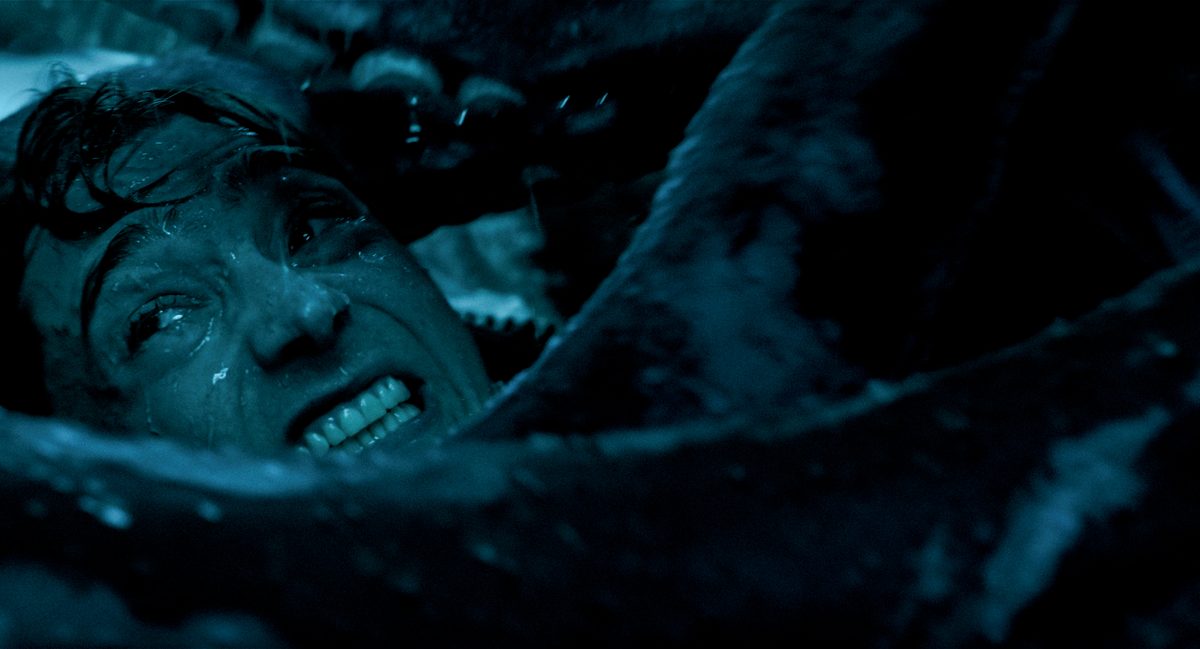
It’s a great hook, especially for a budding star like Abrams. You might expect something destructive, a brutal tear through the belly of the beast – perhaps ridiculous, but enjoyably so. Instead, the film firmly commits to a grounded vision, recreating with technical prowess the gritty suffocation of being trapped inside a writhing whale stomach. Whilst the whale’s swelling innards are an impressive visual, Abrams can only smack against them for so long. The simple lack of things to do inside a whale is a corner that director Brian Duffield is not quite able to fight his way out of.
Zach Cregger’s merciless run-and-gun Resident Evil, proved that Abrams could carry a film with his rough-edged yet boyish charm. His leaking one-liners injected the film with constant humour and helped make him a lovable punching bag. But in its commitment to realism, Whalefall plugs that talent at the source. Due to a lack of oxygen, Abrams can only speak through a mouthpiece. This muffles his unique line delivery and limits the star’s best qualities. Still, the set pieces available to Duffield are well executed. The instant wrestling match between Abrams and the squid that’s been swallowed alongside him is an exhilarating start, as he must wrench himself free from its strangling grasp. Additionally, the sequence of him scaling the whale’s tongue to a view of the sky through its open maw is a brutal high. However, much of the 106-minute runtime is left feeling otherwise dim or frustrating, begging for more from a premise that can only go so far.
So how do you fill a film with such a limited premise? How do you access a character who can’t talk? Flashbacks are Duffield’s poor response. The film routinely cuts to scenes of a shirtless, hyper-macho Josh Brolin, spouting primal wisdom about predators and prey to his son whilst decreeing him as the latter. But Mitt (Brolin) is abusive, irritating, and never compelling. He, like every other tacked-on grief metaphor, is a drag. For a film so committed to dank realism in one half, these soap-opera visions of the past are a jarring choice. The eternally underused talents of Elisabeth Shue, who briefly appears as Abrams’ mother, might have helped these scenes, but alas.
Whalefall echoes the same problems as Duffield’s other films. Like No One Will Save You (a home invasion by aliens) or Spontaneous (high schoolers are randomly exploding), Whalefall has a sellable and exciting premise, but attempts to elevate itself beyond the shallowness of that setting rather than relishing in the dumb-fun of it, causing it to fall short. Whalefall tries to be a touching tale of familial grief, but its shallow metaphors and taxing premise drain the film of its potential. It amounts to a frustrating experience, constantly treading water, and flipping back and forth between two lacklustre halves leaving audiences wincing at the sound of grinding gears.